Lumbar Puncture Training Models
Collaborators: Stanford General Surgery
Lumbar puncture training often relies on physical phantom models that allow learners to practice needle placement before performing procedures on patients. Commercial training models can be costly and may offer limited opportunities for customization.
To explore an alternative approach, the Stanford 3DQ Lab collaborated with Radiology residents and Stanford General Surgery to develop a reusable lumbar puncture phantom for fluoroscopy-guided training. The project focused on creating a lower-cost model that could be manufactured in-house while maintaining realistic imaging characteristics and procedural functionality.
Figure A: 3D render of the provided 3D printed training models to be casted in ballistics gel.
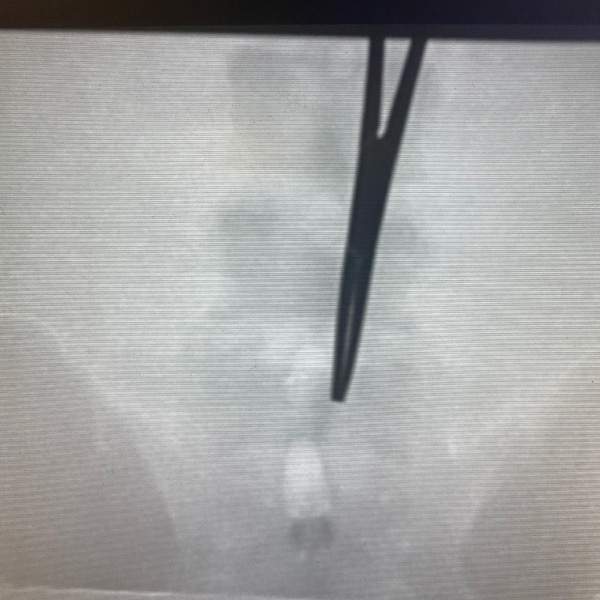
Figure B. Fluoroscopic image of the lumbar puncture training phantom during simulated needle placement.
Development involved evaluating multiple 3D printing materials and construction techniques to identify a suitable balance between durability, radiographic appearance, and procedural realism. The team worked closely with material manufacturers and end users throughout the design process. ABS was ultimately selected for anatomical components, and different infill patterns and densities were explored to better replicate vertebral anatomy under fluoroscopy. A fluid-filled spinal canal and cast materials were incorporated to support repeated training use.
The resulting phantom provided a customizable platform for fluoroscopy-guided lumbar puncture education while demonstrating how 3D printing could be used to create institution-specific training tools.
3DQ Lab – Grant Building
3DQ Lab – Clark Building
Learn More About the Lab
Copyright © Stanford University
