

How are the Measurements Created?
The first step to creating a vascular distance measurement is to obtain a medical imaging scan of the patient’s body. CT (Computed Tomography) and MRI (Magnetic Resonance Imaging), are highly effective for creating these measurements due to their three-dimensional imaging capabilities. A timed-contrast agent can be effective at highlighting specific vascular anatomy during the scanning process by increasing its visibility in the image series.
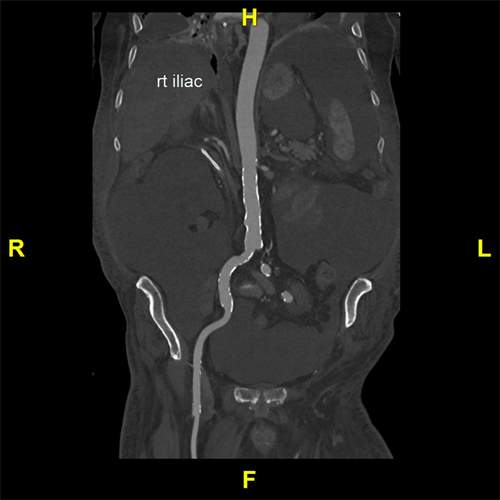
To create vascular distance measurements, the Stanford 3DQ Lab imports the imaging series into specialized software. A Curved Planar Reformation (CPR) is commonly created to view the vessel in question in a stretched-out manner without twists and turns (See Figure A). Two points are selected along the vessel, with the distance between them becoming a measurement of length. Determining where to create these measurements is dictated by a standardized process depending on the patient’s treatment needs or diagnosis.
Figure A: An example of a Curved Planar Reformation (CPR).
The 3DQ Lab creates these measurements for various purposes, including diagnosis, preparation for surgery, and assessments after surgery. The following are some examples of the measurements created by the 3DQ Lab:

Figure B – Pulmonary Valve and Main Pulmonary Artery Measurements: Measurements of the pulmonary valve and the main pulmonary artery are used for planning the replacement of the pulmonary artery via a transcatheter procedure.

Figure C – Renal Artery Length: These measurements are created to evaluate the possibility of surgical intervention for hypertension in patients who have additional or duplicated renal arteries.

Figure D – Post-Stent Measurements: Used for assessing whether a previously placed stent has shifted or if there has been any enlargement of the related aneurysm.

