
4D Flow MRI Pipeline for Pulmonary Hypertension
Chronic thromboembolic pulmonary hypertension (CTEPH) occurs when persistent blood clots obstruct the pulmonary arteries, increasing pressure in the lungs and placing strain on the right side of the heart. Although pulmonary endarterectomy can remove these obstructions, understanding how blood flow and vessel mechanics change after surgery remains challenging.
This study developed a semi-automated pipeline to analyze 4D flow MRI of the pulmonary arteries before and more than six months after pulmonary endarterectomy. The workflow quantified vessel size, wall stiffness, velocity, vorticity, and helicity to characterize how pulmonary artery flow patterns changed during recovery and how those changes related to improvements in pulmonary pressures and right ventricular function.
Publication Link: PubMed
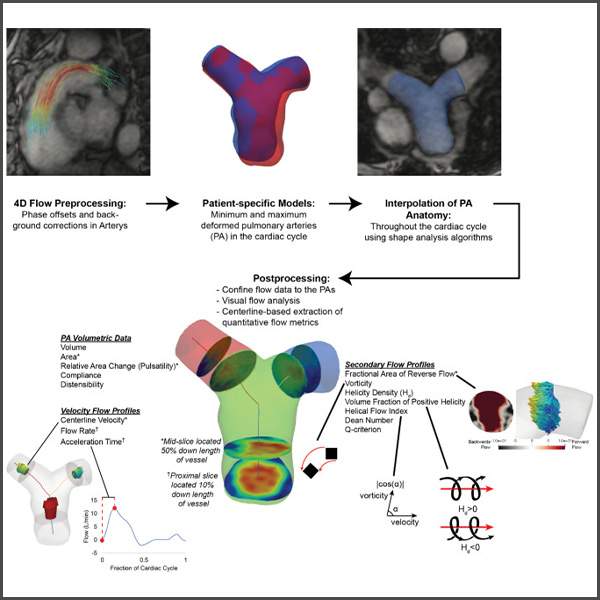
Figure A: Semi-automated 4D flow MRI analysis pipeline showing pulmonary artery segmentation, 3D model generation, and extraction of vessel stiffness and blood flow metrics.
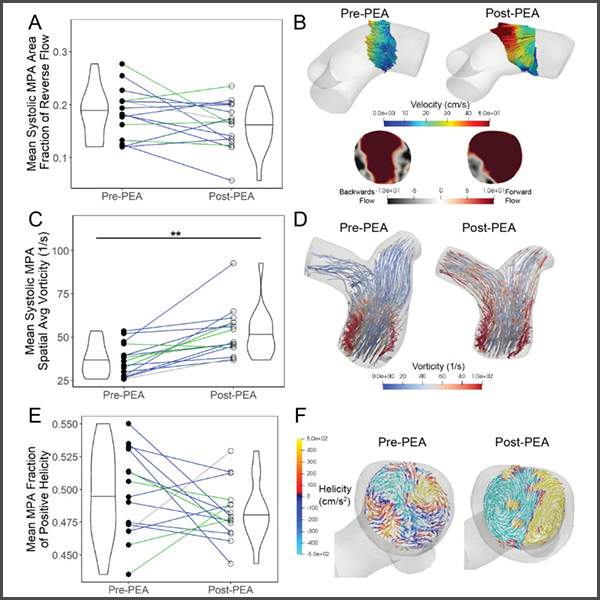
Figure B: Patient-specific pulmonary artery models from patients before and after pulmonary endarterectomy, illustrating the anatomical changes captured across more than 80 segmentations and 3D models created by the 3DQ Lab.