3D and Quantitative Imaging Laboratory
  • Home
  • Education
    • Education
    • Educational Post Feed
  • Research
    • Research
    • Validation Cohort: Acute Uncomplicated Type-B Aortic Dissection
  • Patient Care
    • Patient Care
    • 3D Printing in Medicine
    • 3DQ Lab TRAC Team (Tumor Response)
  • Case Studies
    • Case Studies
    • Innovation Projects
  • Click to open the search input field Click to open the search input field Search
  • Menu Menu

Surgical Theater Support

Collaborators: Stanford Neurosurgery

Surgical Theater is a virtual and augmented reality platform used by neurosurgeons to review patient-specific 3D scenes for surgical planning and intraoperative reference. Before a case can be used in the platform, imaging data must first be processed by a technologist to build a scene that combines the relevant anatomy, pathology, vessels, tracts, and other structures needed for review.

Historically, this scene-building and case coordination work was supported by vendor representatives. Because these representatives frequently changed roles, the neurosurgical team often had to retrain new staff on imaging preferences, workflows, anatomy, and surgeon-specific needs.

Figure A: Surgical Theater scene demonstrating a patient-specific 3D model prepared by the 3DQ Lab for neurosurgical planning.
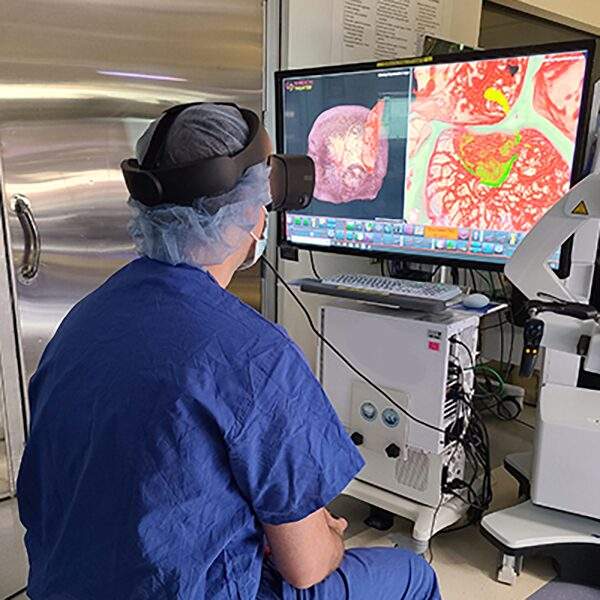
Figure B: Clinician using the Surgical Theater platform to review patient anatomy for case preparation.
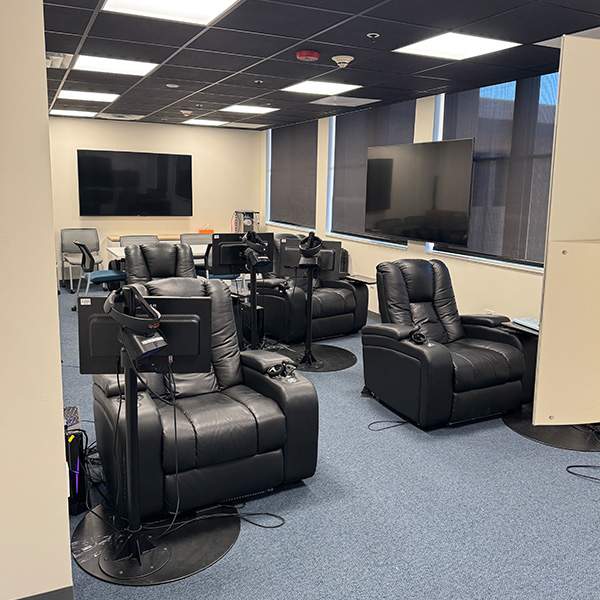
Figure C: Dedicated Surgical Theater VR Studio designed by the 3DQ Lab in collaboration with Neurosurgery.

In 2022, Neurosurgery transitioned this service from the vendor  to the 3DQ Lab for more consistent support. Building on its experience with advanced imaging, the 3DQ Lab assembled a dedicated team that eventually grew to four technologists. In addition to creating Surgical Theater models, the lab developed a cloud-based database and later a custom web portal to manage case tracking, communication, and file sharing. Cases were uploaded to Box to streamline access and eliminate reliance on USB drives. The team also helped design the new Surgical Theater VR Studio in the Alway Building, including room layout, monitor placement, connectivity, and environmental features optimized for image review.

At the end of fiscal year 2026, Neurosurgery elected to return to vendor support, but the collaboration demonstrated how an in-house team could expand and customize this service while providing consistent day-to-day support.

Categories

  • Head & Neck
  • Chest
  • Abdomen & Pelvis
  • Upper Extremity
  • Lower Extremity
  • Case of the Month
  • Techniques

3DQ Lab – Grant Building

300 Pasteur Drive
Stanford, CA 94305

(650) 725-8432

Directions to Grant

3DQ Lab – Clark Building

318 Campus Drive
Stanford, CA 94305

(650) 725-6862

Directions to Clark

Learn More About the Lab

  • About Us
  • Meet the Team
Search Search

Copyright © Stanford University

© Copyright - 3D and Quantitative Imaging Laboratory - Enfold Theme by Kriesi
  • Link to LinkedIn
  • Link to Instagram
Link to: Rosewood Coronary Calcium Scoring Event Link to: Rosewood Coronary Calcium Scoring Event Rosewood Coronary Calcium Scoring Event Link to: Project Baseline Imaging Link to: Project Baseline Imaging Project Baseline Imaging
Scroll to top Scroll to top Scroll to top