AI Evaluation and Deployment
As artificial intelligence applications became increasingly available for medical imaging, healthcare organizations faced new challenges related to evaluation, implementation, and long-term maintenance. Successful adoption required processes to assess performance, validate clinical utility, maintain patient safety, and ensure compatibility with existing systems.
The Stanford 3DQ Lab established a centralized program to support the evaluation and deployment of AI tools within medical imaging. Building on prior experience testing and implementing imaging algorithms, the lab developed standardized workflows to guide AI projects from initial evaluation through clinical deployment and ongoing monitoring.
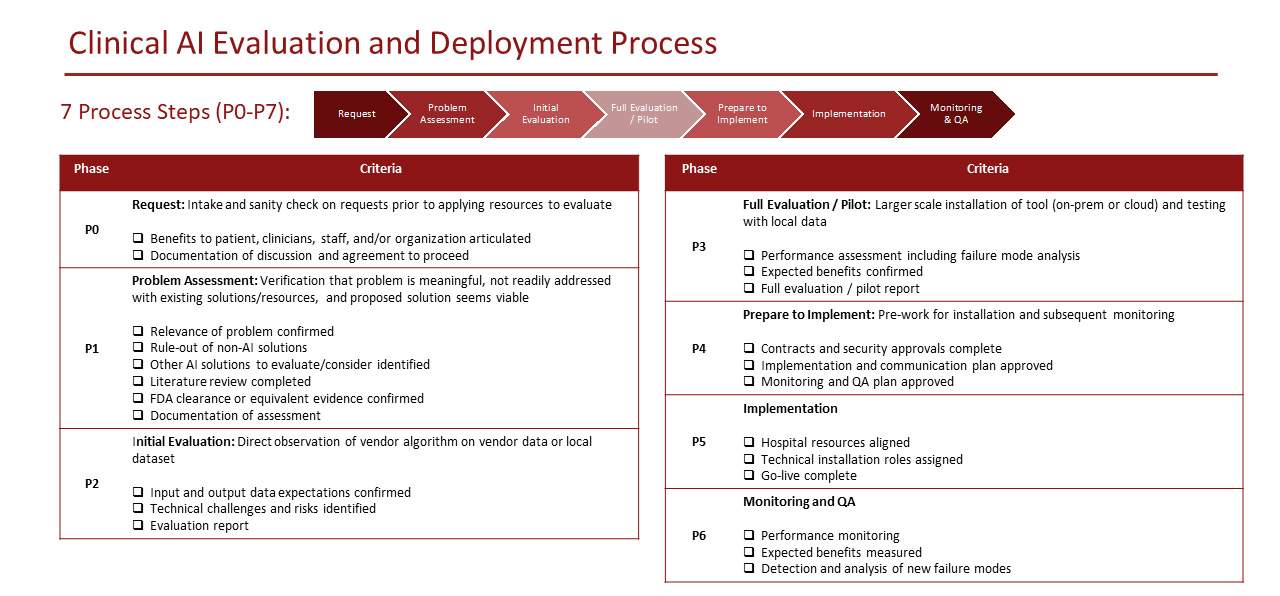
Figure A: Workflow for clinical AI evaluation and deployment.
To support these activities, the lab created an online tracking platform that manages AI projects throughout their lifecycle. The system tracks research, testing, validation, implementation, and maintenance activities while supporting both internally developed and commercially available solutions. Its modular design allows algorithms to be introduced, evaluated, updated, or removed as organizational needs evolve.
The program has expanded to include dedicated personnel focused on AI evaluation, implementation, and support. By providing a consistent framework for assessing and managing AI technologies, the program helps balance innovation, clinical utility, operational requirements, and patient safety across a growing portfolio of imaging applications.
Learn more about our AI evaluation process in our article here.
3DQ Lab – Grant Building
3DQ Lab – Clark Building
Learn More About the Lab
Copyright © Stanford University
