
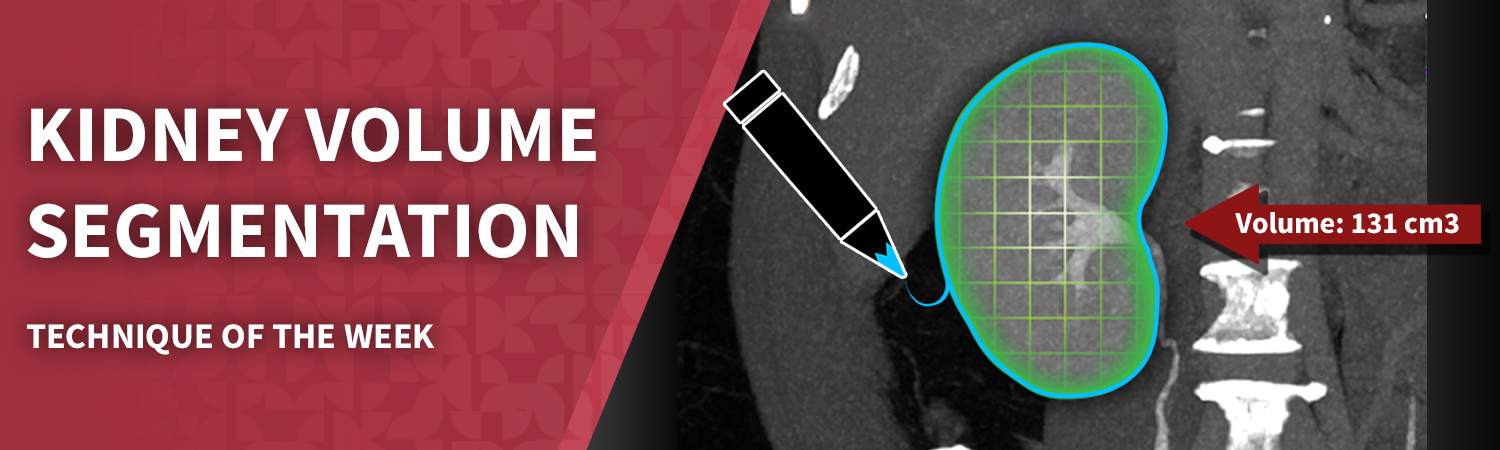
Kidney Segmentation
Segmenting the kidney from medical images to create a kidney volume measurement can be a challenging task due to several factors. First, the contrast in the images can make it difficult to distinguish the kidney from surrounding tissues, especially if the imaging is not of high quality. This is particularly true in CT scans and MRIs where the density and intensity of kidney tissue can closely resemble that of adjacent organs. Additionally, the connecting network of veins and the renal system within the kidney itself adds to the complexity, as these structures must be accurately differentiated from the kidney tissue for precise segmentation. The kidneys’ unique and variable shape also poses a challenge; unlike more uniformly shaped organs, each kidney can have a distinct size and contour, which changes from person to person. This variability means that a one-size-fits-all approach to segmentation is often ineffective, requiring more customized techniques to accurately delineate the kidneys.
Figure A: A demonstration of the tedious segmentation process (coronal view) when using interpolation tools.

A Faster Method
Below is a proven workflow for accurately and quickly segmenting kidney volumes. Take note that the software being used is capable of editing medical imaging data in 3D space.

Figure B: Step 1 – Isolate the kidney from nearby structures in axial, sagittal, and coronal views. This reduces visual obstructions by separating the kidney from the rest of the body.

Figure B: Step 2 – Remove any distinct noise signals different from the kidney’s clear, contrasted edges. This process requires viewing and editing from multiple angles.

Figure C: Step 3 – Trim the vascular structures where they meet the kidney’s cortex, this will likely need to be performed manually in a non-3D view to ensure accuracy.
Other LRD Imaging
In LRD scenarios, the 3DQ Lab offers more than just measurements of kidney volumes. It also supplies detailed imaging about the number and positioning of blood vessels connected to the kidneys. Furthermore, the lab provides virtual reconstructions that display the kidney and its vascular structures in 3D. These images and measurements are important for confirming the compatibility between the donor and the recipient, thereby playing a significant role in the success and safety of the transplant procedure.
Figure E: Visual reconstruction of a kidney donor case. The volume of the original (red) kidney has greatly diminished, and the transplanted kidneys can be seen in green.


