3D and Quantitative Imaging Laboratory
  • Home
  • Education
    • Education
    • Educational Post Feed
  • Research
    • Research
    • Validation Cohort: Acute Uncomplicated Type-B Aortic Dissection
  • Patient Care
    • Patient Care
    • 3D Printing in Medicine
    • 3DQ Lab TRAC Team (Tumor Response)
  • Case Studies
    • Case Studies
    • Innovation Projects
  • Click to open the search input field Click to open the search input field Search
  • Menu Menu

Nuss Procedure Training Model

Collaborators: Stanford Cardiothoracic Surgery

The Nuss procedure is a minimally invasive surgical technique used to treat pectus excavatum, a condition in which the anterior chest wall is sunken inward. During the procedure, a curved metal bar is placed behind the sternum to reshape the chest wall. A cardiothoracic surgeon expressed interest in developing tools to support patient education and fellow training.

Figure A: Rotational volume rendering of the chest wall with bone shown in white and costal cartilage shown in yellow.
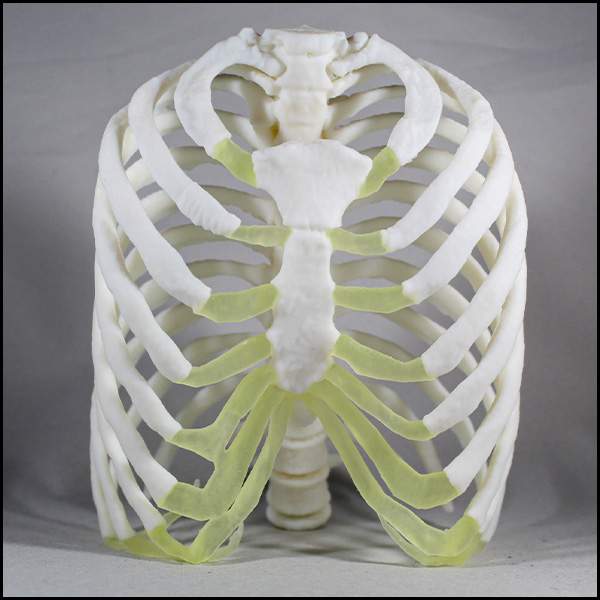
Figure B. Final 3D printed chest wall model with bone printed in rigid white and costal cartilage printed in flexible yellow.

The Stanford 3DQ Lab collaborated with Cardiothoracic Surgery to develop a miniaturized chest wall model designed specifically for Nuss procedure education. The lab performed the segmentation, 3D design, and 3D print production needed to create a physical chest model for Nuss procedure education.

The model incorporated multiple materials to differentiate osseous anatomy from the more flexible costal cartilage. Bony structures were printed using a rigid material, while a softer material was selected for the cartilage to allow limited chest wall movement during simulated Nuss bar placement. This dynamic educational model was intended to be more effective than traditional static anatomical prints.

Categories

  • Head & Neck
  • Chest
  • Abdomen & Pelvis
  • Upper Extremity
  • Lower Extremity
  • Case of the Month
  • Techniques

3DQ Lab – Grant Building

300 Pasteur Drive
Stanford, CA 94305

(650) 725-8432

Directions to Grant

3DQ Lab – Clark Building

318 Campus Drive
Stanford, CA 94305

(650) 725-6862

Directions to Clark

Learn More About the Lab

  • About Us
  • Meet the Team
Search Search

Copyright © Stanford University

© Copyright - 3D and Quantitative Imaging Laboratory - Enfold Theme by Kriesi
  • Link to LinkedIn
  • Link to Instagram
Link to: Vascular Access Training Models Link to: Vascular Access Training Models Vascular Access Training Models Link to: TAVR Meeting Link to: TAVR Meeting TAVR Meeting
Scroll to top Scroll to top Scroll to top